Categories
- Curriculum: Art, Community Service, Dance & Music
- Age/Grade: Above 14, Elementary 3, Middle School
- Subject: Drawing, Painting
- Materials: Paint, Pencils
- Institution: Istituto Professionale De Franceschi Pacinotti
- Location: Italy
- Duration: 2 - 3 Classes
Description
Participants in the “Art in action: color the School” project (students aged
16 and over) created a vibrant mural inspired by Keith Haring, turning plain
school walls into a dynamic explosion of color and movement. Over the
course of 30 hours devoted to artistic expression, the space was
transformed into a lively and engaging work of art in a month.
Objective
Drawing, Painting
Resources
HaringKids.com
Materials
Pencils, construction paper, markers, scissors, tape,
work overalls,interior acrylic paint, brushes, rollers, heliographic prints,
powdered charcoal
Procedure
*The students began by discovering the artistic
language of Keith Haring, observing and analysing a selection of his
large-scale murals. The discussion focused on his striking use of vivid
colours, bold outlines, and simplified figures, as well as his ability to
convey energy, rhythm, and movement through dynamic compositions.
Particular attention was given to the way his figures interact, overlap, and
transform, turning simple shapes into expressive visual narratives.
After this visual exploration, attention turned to the practical phase of the
mural creation. The students prepared their drawings in advance, which
were then transferred onto tracing material and enlarged to match the final
dimensions of the wall. To move from paper to surface, the group was
introduced to the pouncing technique (tecnica dello spolvero), an approach
that allows the precise transfer of outlines onto the wall through the use of
perforated drawings and powdered pigment, ensuring accuracy and
continuity in the final image.
In the final step, the class reflected on how to merge these
elements—Haring’s artistic style and the chosen technique—to develop a
shared mural project, transforming a blank wall into a collective and
meaningful work of art.
MURAL
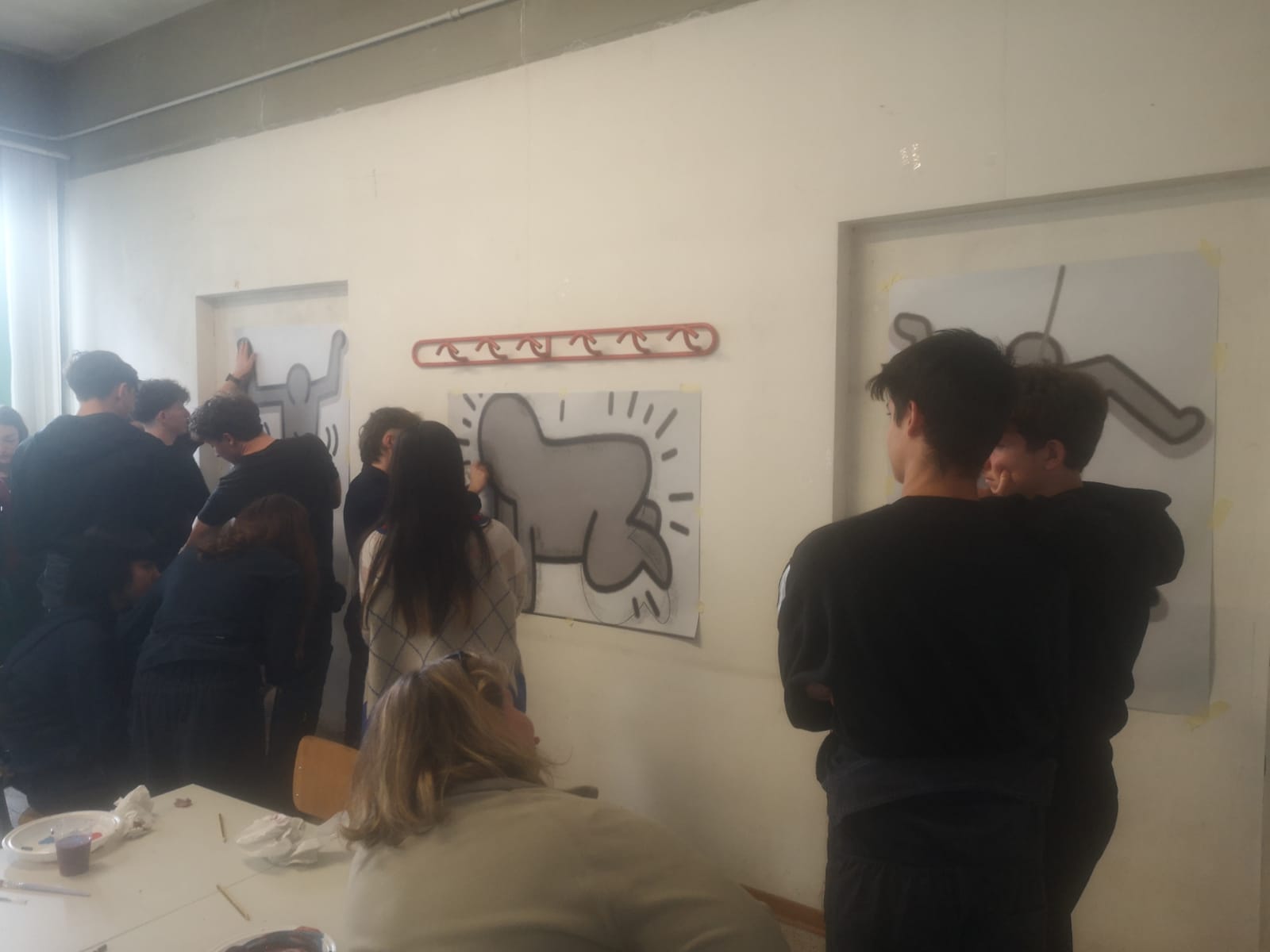
To begin with, the perforated tracing sheets were prepared by carefully
puncturing the outlines of the figures. Once on site, the sheets were
positioned on the wall and the overall composition was discussed, paying
particular attention to balance, layering, and the interaction between the
different elements. After being aligned, the sheets were fixed in place with
adhesive tape. The design was then transferred onto the surface using
powdered charcoal, gently pounced through the perforations. Once the
transfer was complete, the sheets were removed and the outlines were
refined by hand.
Day 2:
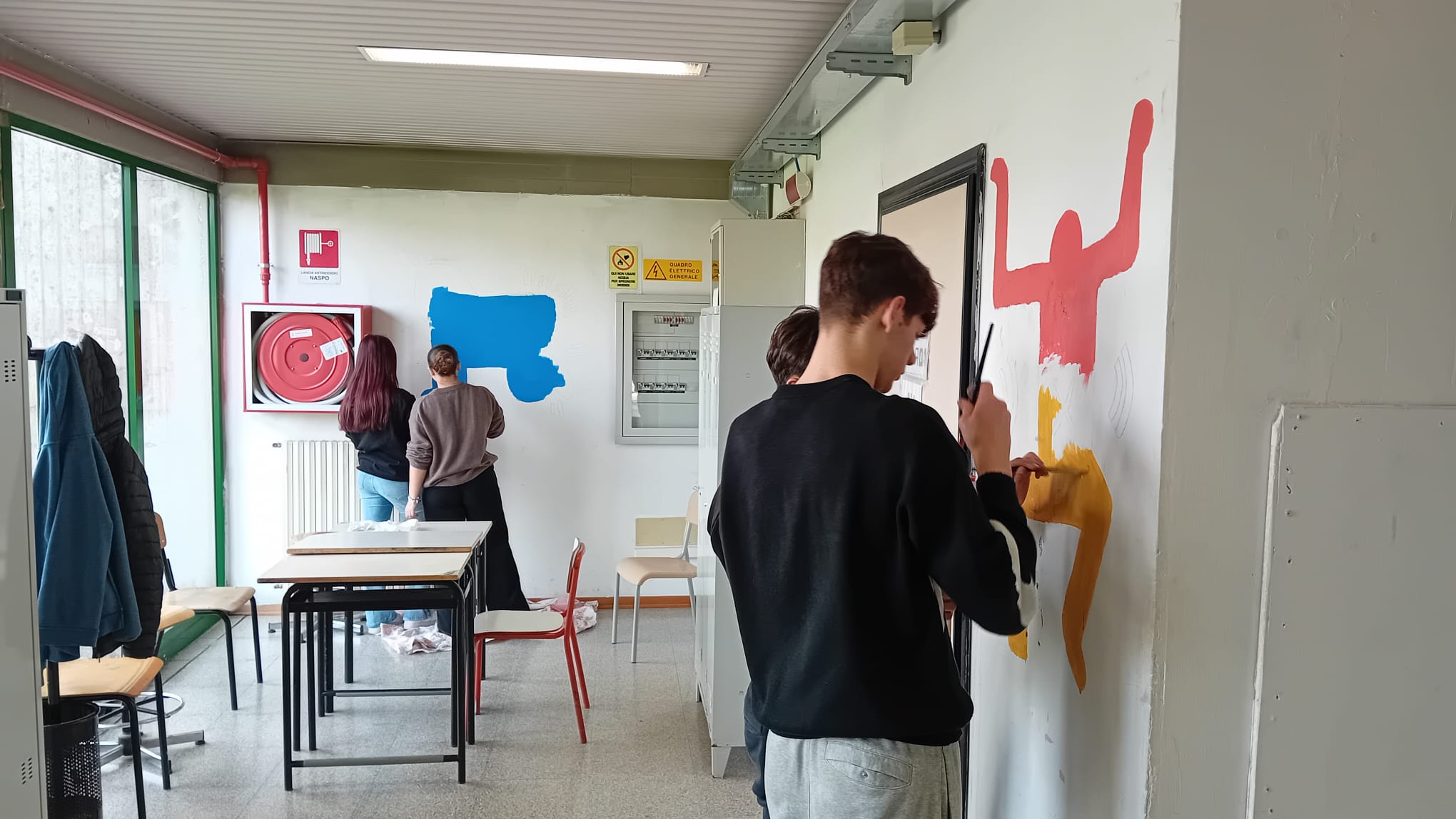
The second day focused on bringing colour into the composition. Each
figure—human and animal—was assigned a specific colour, inspired by the
bold and vibrant palette of the 1980s, including shades such as fuchsia,
deep lime green, bright blue, and red. Care was taken to ensure that figures
of the same colour were not placed next to each other, enhancing contrast
and visual impact.
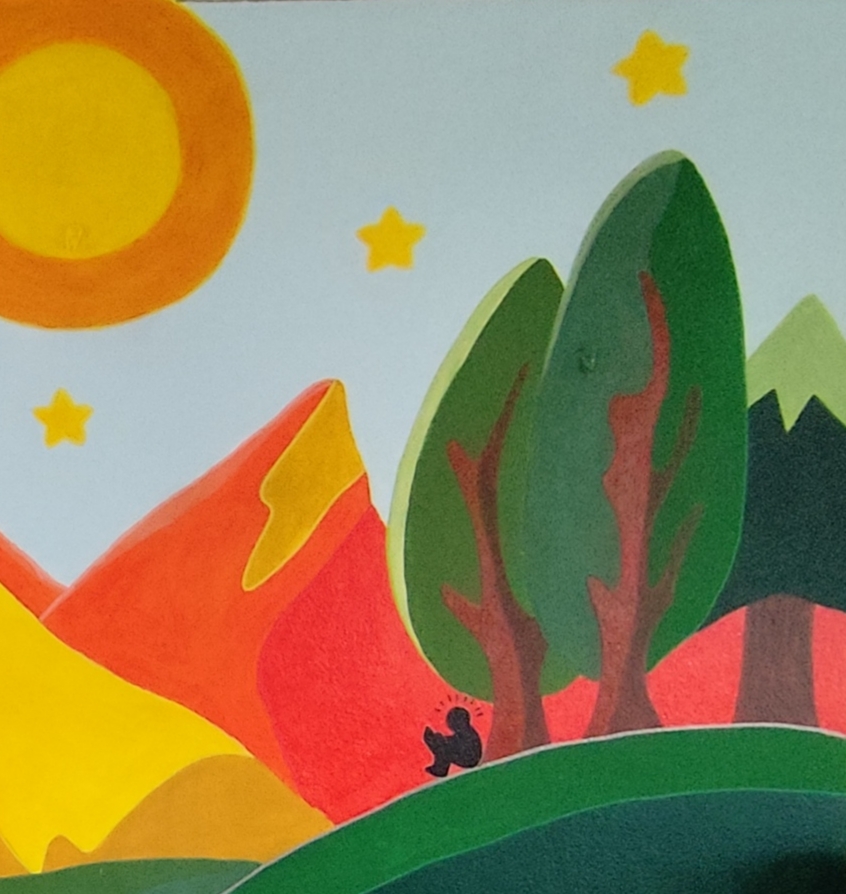
In addition to the original figures, the mural was enriched with new
freehand elements, such as the sun, moon, stars, clouds, a small
cityscape, a large mushroom, and imaginative plant forms. These additions
helped expand the narrative and visual complexity of the work.
A neutral background was chosen to unify the composition, and a
significant portion of the day was devoted to painting it. Multiple layers of
paint were required, as the wall surface was uneven and marked by
previous graffiti, making the coverage more challenging but also more
rewarding.
Day 3:
The final day began with the application of a last coat of background colour
to achieve a clean and even surface. After this step, the mural was left to
dry for a couple of hours while the group engaged in other artistic activities
connected to the broader project but independent from Haring’s style.
In the final stage, attention was given to detail and refinement: the black
outlines were strengthened, dynamic motion lines were added around the
figures to enhance their sense of energy, and final adjustments were made
to fill remaining empty spaces, bringing the mural to its completion.